
You know that old saying, “The more things change, the more they stay the same”. Such is the case with Photodynamic therapy (PDT). We have been doing this procedure in the office for 20 years! There have been some slight changes, but overall, this remains a mainstay of treatment for our patients.
Let’s talk about PDT and why it is one of my favorite procedures. Photodynamic therapy is a procedure we use in the office for multiple reasons. It can be used to treat acne, rosacea, and actinic keratoses. Plus, it has great cosmetic outcome, improving the texture and tone of the skin, reducing wrinkles and overall giving a more youthful look to the skin. Sounds great! What’s the catch?
Insurance only covers this as a treatment for precancerous Actinic Keratoses (AK), so 99% of the time we do this in the office it is for Aks. The other things are just a fringe benefit for those having this procedure. There are other treatments available for Actinic Keratoses, so let’s review those.
When discussing treatment options for Actinic Keratoses, precancerous red scaling spots, I usually present patients with three major choices. For a more detailed review of all the choices, see our Actinic Keratosis information sheet or our Actinic Keratosis 101 website page. In general, the three major options and their ups and downs are…
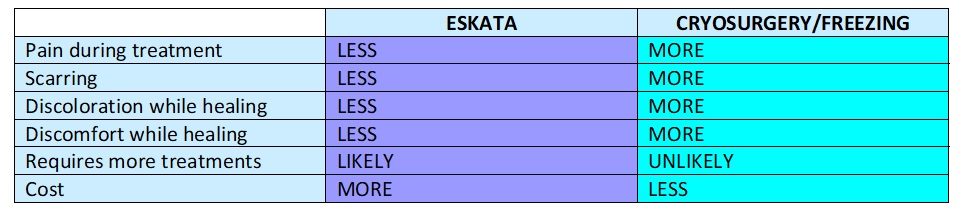
- Cryosurgery or freezing –This works best if there are just a few lesions. The benefit is that it is quick and easy, and most insurances cover this therapy. After treatment in the office, the treated spots usually fall off in 7-21 days. The biggest negative is that it can leave some discoloration or a scar.
- Creams – There are a variety of chemotherapy creams available. Generally, I consider this to be the most effective and thorough option, but it is miserable and sometimes expensive. As a positive, it can be thoroughly applied to a large area. Application of creams to the area causes destruction of any abnormal cells. Lesions usually resolve nicely without any discoloration or scarring. However, any abnormal areas turn red, scabby and crusty for about 6 weeks. Most of the creams are applied for 30 days and it takes a few weeks for the reaction to resolve. At this time,the price on these creams is relatively reasonable using GoodRx.
- Photodynamic therapy (PDT)- is a light treatment that is done in the office and is covered by many but not all insurances. Usually performed on the entire face or scalp, the benefit again is that we can be very thorough without the extensive redness, scabbing and crusting. Patients do have what looks and feels like a decent sunburn that peels for about 4-7 days.The negative is cost. If not covered by insurance, it is approximately $600.
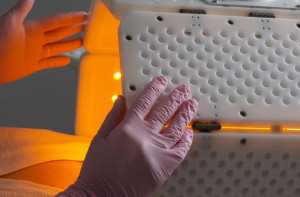
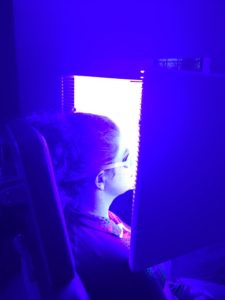
Photodynamic therapy (PDT) is an office-based treatment. After washing the area to be treated, a solution called Aminolevulinic acid (brand names Ameluz or Levulan) is applied. The solution is then allowed to incubate for at least 60 minutes. During the incubation period, the solution is preferentially absorbed by abnormal precancerous cells. After the incubation period, the patient sits under a panel of lights for about 10 minutes. As an additional benefit, the solution is also absorbed by oil glands causing improvement in enlarged oil glands, rosacea and acne. Finally, this treatment greatly improves the appearance of the skin all around improving texture, tone, and youthfulness of the skin.
If you think PDT might be a good option for you, let’s discuss the fine print.
Who is a candidate?
Patient with diffuse actinic keratoses, moderate to severe acne and/or rosacea, or moderate to extensive sun damage are good candidates for photodynamic therapy. If you have been on Accutane within 3 months or have an active cold sore, you should not have this procedure. Again, insurance only covers for precancerous actinic keratoses.
How many treatments are required?
For precancerous actinic keratosis, recent studies show that patients have a better longer-term result if two treatments are performed within a few months. Occasionally, thicker actinic keratoses may not fully respond to light treatments, and alternative treatments, such as cryotherapy or topical chemotherapy, may be necessary for difficult residual lesions. Subsequent actinic keratoses may develop over time, and future treatments may be needed. If there is one lesion that is particularly resilient, we will biopsy any resistant lesion.
Acne breakouts and rosacea can be greatly reduced in four treatments. Rosacea and acne can be chronic conditions, and maintenance treatments may be necessary to remain in remission.
Are there any negatives?
Some patients experience minimal tingling and burning when the solution is first applied. Rarely, patients experience discomfort while sitting under the lights. ALL PATIENTS will be extremely sensitive to ALL LIGHT for 24 to 48 hours. For this reason, we recommend that patients STAY INSIDE in dim light especially for the first 24 hours. Sunscreen WITH ZINC will need to be applied every 2 hours while awake for the first 36 hours. Those who follow this instruction experience redness and peeling similar to that seen with a decent sunburn that resolves in 4-7 days.
PATIENTS WHO DO NOT FOLLOW THESE INSTRUCTIONS WILL HAVE SEVERE REDNESS AND BLISTERING, LONGER HEALING TIME AND POSSIBLE SCARRING!
Also, if someone is prone to having cold sores, the treatment could bring on a cold sore. If you are prone to cold sores or if you have had shingles on your face, please let us know so we can prescribe you preventive medications.
What happens after Photodynamic Therapy?
A sunblock containing zinc oxide should be used every 2 hours while awake UNLESS YOU ARE IN A COMPLETELY DARK ROOM for at least 36 hours following a treatment. Consider a broad rimmed hat even when going to and from your car. Makeup may be applied immediately after your treatment. Normal skin care can be resumed after 36 hours. It will take at least 6-8 weeks to see the full result.
Can another type of light be used? In the past we primarily used blue light, but now we use red LED light. We can use intense pulsed light which may be more effective for those with rosacea or discoloration. Also, studies have tried using outdoor UV light, but this result is unpredictable due to variations in UV exposure..
What is the cost of Photodynamic Therapy?
For the treatment of actinic keratoses, most insurances including Medicare now cover this procedure. However, treatments for conditions such as acne, rosacea, and sun damage are at this time rarely covered by insurance.
Are there ways to improve the efficacy of PDT for actinic keratoses? Yes, a number of things have been shown to improve efficacy.
Pretreating with a retinoid. Retin A helps remove old skin cells to prepare the skin to more readily absorb ALA. The most inexpensive and least irritating way to prepare the skin with a retinoid is using Differin (generic – adapalene) available OTC and by prescription. We recommend pretreating with Differin or another retinoid nightly for three weeks prior to PDT.
Saran Wrap. Wow, now that is scientific advancement. Seriously! In dermatology we often place medications on the skin “under occlusion” to increase their penetration. We use plastic wrap to improve penetration on the scalp and other non-hair bearing flat areas. On the face, we can also use a plastic gel mask to improve penetration. Dr Rosenberger often does this on stubborn spots that have not resolved with previous treatments.
Heat. There have been several studies evaluating ways to make the ALA penetrate better and more effective. In addition to occlusion with plastic wrap, heat can improve efficacy. We can heat using warm packs and warming gel masks. Again we tend to use heat in treatment resistant cases.
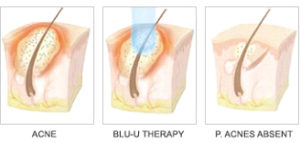
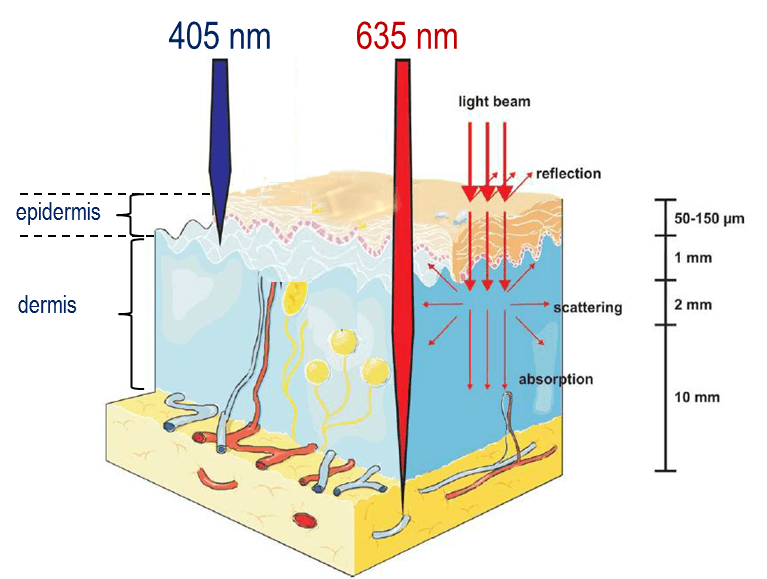
Red light. ALA can be activated by both red and blue light. The benefit of red light for treating precancerous cells and sun damage is that red light penetrates deeper in the skin than blue light. However, blue light remains the treatment of choice for acne and rosacea, because only blue light targets bacteria seen in acne and rosacea.
I hope this review helps you see why PDT is one of our longest standing and favorite treatment in the office. We see great results and most patients find it a tolerable and effective procedure.
What are the POST CARE INSTRUCTIONS for Photodynamic Therapy?
· Avoid bathing or washing with very hot water. Use tepid water.
· You may look and/or feel like you have a mild to moderate sunburn. This should fade within 1-7 days. Occasionally there is swelling under the eyes.
· Wash the face gently with a gently cleanser like Cetaphil, nothing abrasive.
· If you do not have any signs of blistering, peeling, or crusting, you can continue the majority of your facial care regimen and makeup can be applied as usual on the day after the procedure. EXCEPTION … RetinA/Tazorac/Tretinoin/Differin and mechanical/chemical exfoliants should not be applied for one week after the treatment or until all peeling is resolved.
· Rarely an acne-like eruption, cold sore eruption, blistering, minor crusting can occur. Apply Aquaphor or Vaseline three times a day to any open or crusted area and call the office immediately. Call the office and ask to be seen ASAP if any of these reactions other than minor peeling occur. Dr Rosenberger can minimize any long-term side effects from these reactions if treated promptly.
· Any pigmented lesions, age spots or freckles treated may turn darker within the first 12 hours after treatment. These lesions will stay dark until the skin sheds over the next 1- 3 weeks. Do not pick at or scrub these areas.
· YOU WILL BE EXTREMELY SENSITIVE TO THE ALL LIGHT. FAILURE TO FOLLOW THESE PRECAUTIONS WILL LEAD TO ADVERSE SIDE EFFECTS. A sunblock containing zinc oxide with an SPF# 30 or higher should be used for at least 36 hours following a treatment. APPLY SUNBLOCK EVERY 2 HOURS WHEN AWAKE FOR 36 HOURS. Consider a broad brimmed hat even when going to and from your car. Apply pure zinc oxide thickly to the treated area if you need to be exposed to the sun. Make up may be applied on top of the sunscreen. You may not go in a tanning booth at any time either before or during these treatments.
-Continue to wear a zinc oxide sunscreen of SPF 30 daily for at least 2 weeks after your procedure. The use of sun protection is recommended when going outdoors to minimize hyperpigmentation and damage to your newly rejuvenated skin.
· Do not pick at or disturb the treated area in any way.
· Remember that the stimulation and growth of collagen is a slow process. Maximal improvement in acne, rosacea, precancer spots, skin tone, skin texture and erythema/redness will not be seen for 4-6 weeks.
· Additional treatments may be required or recommended for desired results. Often multiple procedures are required.
If you know someone who may find this article helpful, please share it with them! Follow us on social media this week, and subscribe to our growing YouTube channel! If you would like to receive these posts in your email inbox, Subscribe to our Site.
















 Laser Vein Reduction Treatments



 DP Dermaceutical Products