Tinea Versicolor

5 Answers to Common Questions about this Condition

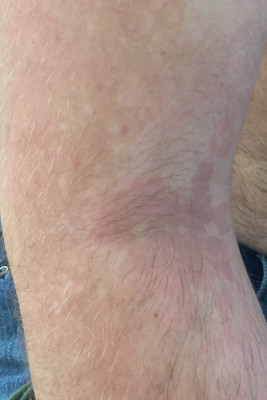
What is this discolored rash on my chest, back, and arms? Tinea versicolor, otherwise known as pityriasis Versicolor, is a harmless but cosmetically disturbing rash that is most often seen on the trunk, arms, and neck.  It is sometimes itchy, but not always.  It can be a variety of colors, thus the name “Versicolor.” In pale-skinned individuals, it usually appears pink or brown.  In dark-skinned individuals, it usually appears paler than the surrounding skin.
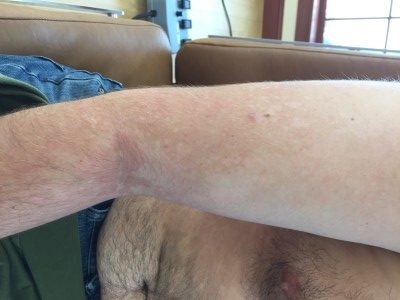
Tinea versicolor on the arm
Tinea versicolor magnification shows the varying colors

1-What causes it?  Tinea versicolor is caused by an overgrowth of a yeast called pityrosporum ovale, which is a harmless yeast that normally grows to some extent on everyone’s skin, so it is not really contagious.  It is not the same as Candida yeast, and it is not a fungus.  In some people, the yeast overgrows.  Usually, overgrowth is stimulated by excessive sweating and moist, oily conditions.

2-If it is harmless, do I need to treat it?  Not really, but yes.  A confusing answer, I know.  Most people who leave it untreated eventually have a rash on their entire trunk.  It will become itchier and disfiguring in time.

3-Why does it cause discoloration?  And why is it different colors on different people?  The red comes from inflammation in the skin triggered by the yeast.  The tan or brown is a result of thickening and scaling of the skin in response to the yeast.  Both of these resolve quickly with treatment.  The pale discoloration or what dermatologists call hypopigmentation (less pigment) is more stubborn.  The yeast temporarily stuns the pigment cells and slows the production of pigment.  This is exacerbated by sun exposure, often leaving a “tan line” that will not even out until the tan is gone.

4-How can I prevent overgrowth of the yeast?  For those who are prone to overgrowth of the yeast, washing the body 1-2 times a week with Selsun Blue shampoo will reduce the overgrowth of the yeast.  However, a visible rash usually requires topical or oral anti-yeast medications.  I have seen a number of young women with this condition who are actively using tanning beds, so please stay out of those tanning beds.

5-How do the pills work?  For patients with extensive rash, the application of topical medication for a few weeks is often impractical. So, sometimes we use pills to treat this condition.  However, it can be difficult for the anti-yeast medication to get from the mouth to the skin.  So, here’s the trick:  We recommend patients take the pills, wait about one hour, then sweat profusely AND leave the sweat on for about 8 hours.  We do this once and repeat it in about two weeks.  Gross and stinky, but it works.

Remember, even after the condition is treated, it may take 6-12 weeks or more for the discoloration to resolve, so be patient during treatment.

For more information, these are some additional helpful resources from the American Academy of Dermatology.


If you know someone who may find this article helpful, please share it with them! Follow us on social media this week, and subscribe to our growing YouTube channel!

If you would like to receive these posts in your email inbox, Subscribe to our Site.


What’s that Mite Living in Your Pores?

Demodex

Whats that mite living in your pores? 

Demodex is a microscopic mite that normally lives on the skin of humans and other mammals.  Two types of Demodex live on humans Demodex folliculorum and Demodex Brevis.  Although Demodex is considered a normal part of the skin flora or biome, dermatologists have long known it to play a role in some skin disorders including rosacea and seborrheic dermatitis. 

These mites feed on dead skin and sebum and are usually found only on the face, scalp, and ears.  Most of the time they dont cause any problems, but when found in large numbers they can cause or exacerbate a number of skin conditions. When these mites overgrow and cause problems we call it demodicidosis.  Now, to be honest, I dont see Demodex as a huge problem in my practice and I rarely talk about them.  Talking about mites freaks people out and makes them worry about scabies. I attribute the lack of Demodex problems in my patients to one major thing – Sulfur wash.   

I prescribe a lot of prescription-strength sulfur wash in my practice.  For acne, rosacea, and seborrheic dermatitis sulfur wash often helps immensely.  One part of the efficacy of sulfur wash is its control and killing of Demodex mites.  Its a side benefit at least.  For those who dont have a prescription-strength sulfur wash, Selsun Blue shampoo often can do the trick as well. 

 A few questions you might have… 

Are Demodex mites contagious?  Yes, but skin to skin contact, but since we all have them to some degree it doesnt matter so much. 

Should I worry about Demodex?  Not unless you have Rosacea or seborrheic dermatitis (dandruff of scalp or face).  To learn more about Seborrheic Dermatitis, check out our previous post.  

What kills Demodex mites?  A number of things kill them and keep them under control, but the most commonly used are a sulfur wash, Selsun blue shampoo, and topical ivermectin (Soolantra). 

 Sulfur wash – Actually these prescription-strength washes usually contain sodium sulfacetamide and sulfur as their active ingredients.  We usually recommend washing acne, rosacea, and seborrheic dermatitis prone areas once or twice a day.   

 These are available by a number of companies.  We sell the ZO Sulfur Masque in the spring Boutique and include it in our facials for acne and rosacea. 

Selsun Blue – Simple, cheap, and effective when purchased OTC.  Wash dandruff areas of the face and scalp a few times a week.  If you have dandruff on your scalp, dont be afraid to wash it daily.  You will NOT dry out your scalp.  The dryness and flakiness come from dandruff NOT from washing too much.  Wash more, not less. 

Topical Ivermectin (Soolantra) – Soolantra is the newest of the topical medications for rosacea designed with Demodex in mind.  This topical also is anti-inflammatory and proved to be more effective than the old standard metronidazole gel.  For those with rosacea whose insurance does not cover Soolantra or sulfur wash, washing weekly with a dandruff shampoo often works. 

What is the difference between Demodex and scabies?  They are totally different types of mites.  Demodex is normal on the skin and scabies is not normal. Scabies mites always cause problems.   

Is there anything good about Demodex?  As part of the skin biome (see prior post) mites do produce free fatty acids from sebum and may play a role in protecting the skin from pathogenic bacteria.  

If you know someone who may find this article helpful, please share it with them! Follow us on social media this week, and subscribe to our growing YouTube channel!

If you would like to receive these posts in your email inbox, Subscribe to our Site.